
French Bulldog Colors: Standard, Rare & Health Guide
Introduction
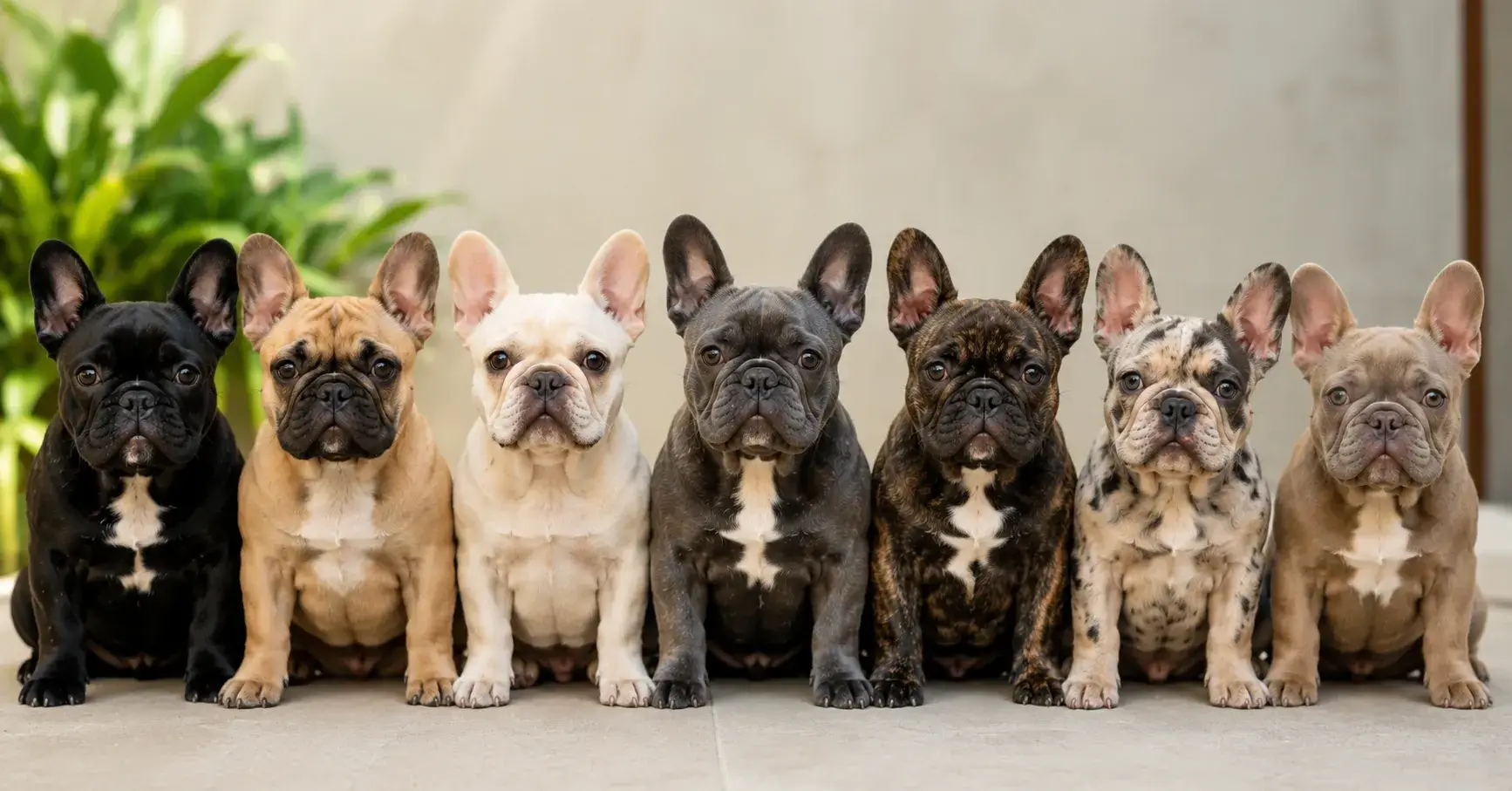
French Bulldog colors range from classic brindle and fawn to eye-catching shades such as blue, chocolate, lilac, and Isabella. You may also see patterns such as pied, brindle, tan points, and merle advertised by breeders.
But there is an important difference between a color that exists in French Bulldogs and a color that is recognized by the breed standard.
Some rare-looking Frenchie colors are not accepted under the American Kennel Club (AKC) breed standard, and some coat-color genetics can be associated with health concerns. That makes it important to look beyond a puppy’s appearance when choosing a French Bulldog.
In this complete guide to French Bulldog colors, you’ll learn the standard colors and patterns, what rare colors mean, how coat-color genetics work, which colors are disqualified from the AKC show ring, potential health considerations, and what to look for when choosing a healthy Frenchie.
What Are the Standard French Bulldog Colors?
The official French Bulldog standard recognizes brindle, fawn, white, and combinations of these colors and patterns, including brindle and white and fawn and white.
The standard also describes black masks, black shading, and white markings.
One important detail is often missed online: brindle is technically a pattern rather than a simple base color. It consists of black hairs over a fawn background, and the amount of black can vary considerably.
The AKC standard states that colors, markings, and patterns outside those specifically described are disqualifying in conformation competition.
1. Brindle French Bulldog
Brindle is one of the classic French Bulldog patterns.
A brindle Frenchie has a fawn background with darker hairs forming stripes or bands. The pattern can be light, with clearly visible fawn areas, or so dark that the dog appears almost black from a distance.
A very dark brindle is sometimes called a black brindle, but it should still show a trace of the fawn background to meet the breed-standard description.
Brindle can also appear with white markings, creating a brindle-and-white or pied-style pattern.
2. Fawn French Bulldog
Fawn can range from a pale cream-like shade to yellow, tan, or deeper reddish tones.
Some fawn French Bulldogs have a black mask around the muzzle, while others have little or no visible mask.
Because fawn can vary considerably in shade, two fawn Frenchies may look quite different while still falling within the same broad color category.
3. White French Bulldog
White French Bulldogs have predominantly white coats.
White can also appear as part of a patterned coat rather than as an entirely white dog. The amount and distribution of white markings can vary.
When looking at a very white Frenchie, it is important to consider more than coat appearance. Pigmentation around the eyes and ears and the dog’s overall health and breeding background are more useful than simply labeling the puppy as “rare.”
4. Brindle and White French Bulldog
Brindle and white French Bulldogs have a white base or substantial white areas combined with brindle patches.
The brindle portions should still show the characteristic brindle pattern.
This is commonly referred to as a pied pattern, although pied describes the distribution of color rather than being a separate base color.
5. Fawn and White French Bulldog
Fawn and white French Bulldogs combine fawn patches with white.
The fawn areas may be light tan, deeper reddish fawn, or somewhere between the two.
As with other pied patterns, every puppy can have a different distribution of colored and white areas.
French Bulldog Colors vs. Patterns: What’s the Difference?

This distinction makes French Bulldog colors much easier to understand.
A color describes the pigmentation, while a pattern describes how that pigmentation is distributed across the coat.
For example:
- Fawn is a base color.
- Brindle is a pattern.
- White can form part of a patterned coat.
- Pied describes a white-and-colored distribution.
- A black mask is a marking.
- Tan points describe a pattern of lighter markings.
- Merle is a coat pattern rather than a simple base color.
This means a Frenchie can have combinations such as:
- Fawn brindle
- Brindle and white
- Fawn and white
- Fawn with a black mask
- Blue pied
- Chocolate pied
- Lilac and tan
However, not every combination is accepted by the official French Bulldog breed standard.
French Bulldog Colors Chart
| French Bulldog Color or Pattern | General Description | AKC Show Status |
|---|---|---|
| Brindle | Fawn base with black striping | Recognized |
| Fawn | Tan to reddish or pale fawn | Recognized |
| White | Predominantly white coat | Recognized |
| Brindle & White | Brindle patches with white | Recognized |
| Fawn & White | Fawn patches with white | Recognized |
| Black Mask | Dark facial marking, usually on fawn | Recognized marking |
| Blue | Diluted black/gray appearance | Disqualifying |
| Blue Fawn | Fawn with dilute pigmentation | Disqualifying |
| Black & Tan | Black coat with tan points | Disqualifying |
| Solid Black | Black without brindle trace | Disqualifying |
| Liver/Chocolate | Brown-based pigmentation | Disqualifying |
| Merle | Mottled or patchy pattern | Disqualifying |
The exact show-standard terminology matters, so buyers should not assume that a breeder’s marketing name means the color is officially recognized.
What Are the Most Common French Bulldog Colors?
Brindle and fawn are among the most familiar French Bulldog colors.
Brindle can range from relatively light striping to very dark brindle. Fawn can also vary substantially in shade.
Pied combinations are also well known and may feature either brindle or fawn patches on white.
If you’re choosing a Frenchie primarily as a companion, there is usually no practical advantage to paying extra simply because a coat is unusual.
What Are Rare French Bulldog Colors?
You will often see breeders advertise these as rare French Bulldog colors:
- Blue
- Blue fawn
- Blue pied
- Blue brindle
- Chocolate
- Chocolate fawn
- Chocolate pied
- Lilac
- Isabella
- Tan-pointed combinations
- Merle
Some of these are produced through recessive or dilution-related genetics, while others involve patterns that are not part of the official breed standard.
“Rare” does not automatically mean better, healthier, or more valuable.
In fact, the opposite can sometimes be true when breeding decisions prioritize appearance over health.
Blue French Bulldog

Blue French Bulldogs usually have a gray or slate-colored appearance caused by dilution of black pigment.
At the genetic level, the dilute locus can change black pigmentation toward blue-gray shades.
The University of California, Davis Veterinary Genetics Laboratory identifies the dilute gene as one of the major coat-color genes tested in French Bulldogs.
Blue is not an accepted French Bulldog color under the AKC standard.
Are Blue French Bulldogs Healthy?
A blue coat does not automatically mean a dog is unhealthy.
However, dilute pigmentation can be associated with color dilution alopecia (CDA) in dogs. CDA can cause hair thinning or loss and skin changes in affected animals.
That does not mean every blue Frenchie will develop CDA. It does mean that buyers should not assume a rare color is risk-free simply because the puppy looks healthy.
Health testing, responsible breeding, veterinary care, and the individual dog’s health history matter far more than the color itself.
Chocolate French Bulldog
Chocolate French Bulldogs have brown rather than black pigmentation.
Chocolate is associated with variants at the B locus, and the trait is generally recessive, meaning a puppy needs the appropriate genetic combination from its parents to express the color.
Chocolate can appear in combinations such as:
- Chocolate
- Chocolate brindle
- Chocolate pied
- Chocolate fawn
- Chocolate and tan
Although chocolate Frenchies can be visually striking, the color itself does not make a dog healthier or more valuable as a companion.
Lilac French Bulldog
Lilac is commonly used by breeders for a pale, diluted coat produced by combining chocolate/brown and dilute genetics.
In simple terms, the combination of brown pigmentation and dilution can produce a lighter grayish or lavender-like appearance.
Lilac Frenchies may have lighter noses and eyes than standard-colored dogs.
Because lilac is a non-standard color, buyers should be especially careful about breeders who use the word “rare” as a substitute for documented health testing.
Isabella French Bulldog
Isabella is another breeder term used for a highly diluted brown-based coat.
Genetic testing is useful because coat appearance alone does not always reveal the exact genetic combination carried by a dog.
The University of California, Davis Veterinary Genetics Laboratory notes that the dilute gene can modify black pigment toward blue and brown pigment toward lilac or Isabella shades.
The important point for buyers is simple:
A rare name does not equal superior health.
Ask about the parents, health testing, genetic screening, and veterinary records before considering the color.
Merle French Bulldog
Merle produces a mottled or patchwork appearance in the coat.
It can create areas of diluted pigment that make the coat look spotted, marbled, or uneven.
Merle is not recognized in the AKC French Bulldog breed standard.
Why Is Merle Breeding a Concern?
The major genetic concern is producing puppies that inherit two copies of the merle variant.
Double-merle dogs have an increased risk of serious pigment-associated abnormalities, including hearing and eye problems.
For that reason, responsible breeding programs should not intentionally produce double-merle puppies.
If someone is selling a merle French Bulldog, ask for documentation about the parents’ genetic testing rather than relying only on the puppy’s appearance.
What About Black and Tan French Bulldogs?

Black and tan French Bulldogs have a dark base coat with lighter tan markings around areas such as the face, chest, legs, and eyebrows.
The pattern can look similar to black-and-tan dogs in other breeds.
However, black and tan is not an accepted French Bulldog color under the AKC standard.
This distinction is important if you’re buying a Frenchie for showing or comparing a breeder’s claims with the official breed standard.
Can French Bulldogs Be Completely Black?
A French Bulldog that looks completely black may actually be an extremely dark brindle.
The AKC standard specifically distinguishes solid black from brindle and states that black means black without a trace of brindle.
A truly solid black coat is a disqualifying color under the standard.
So if a breeder advertises a “rare pure black Frenchie,” ask exactly how the puppy is classified and whether there is any brindle trace.
What Is a Pied French Bulldog?
Pied describes a coat pattern where white makes up a substantial part of the coat and colored patches appear over the body.
The colored patches may be:
- Brindle
- Fawn
- Other non-standard colors in dogs produced outside the breed standard
Standard French Bulldog examples include brindle and white or fawn and white.
The amount and location of colored patches can vary greatly from one puppy to another.
What Is a French Bulldog With a Black Mask?
A black mask is a darker area around the muzzle and face, most commonly seen on fawn French Bulldogs.
It is a marking rather than a separate color.
Some Frenchies have a strong, clearly defined mask, while others have a lighter or less obvious one.
A black mask should not be confused with a black coat.
French Bulldog Color Genetics Explained Simply
French Bulldog coat color is controlled by multiple genes working together.
Some of the major genetic systems involved include:
- A locus affects patterns such as fawn and tan-point distribution.
- B locus: affects brown/chocolate pigmentation.
- D locus: affects dilution, including blue-type pigmentation.
- E locus affects whether pigment expression is masked or shifted toward cream.
- K locus: helps control black pigment and brindle expression.
- S locus contributes to white spotting/piebald patterns.
- M locus: produces the merle pattern.
The University of California, Davis Veterinary Genetics Laboratory offers French Bulldog coat-color testing covering several of these genetic traits.
This is why two French Bulldogs that look similar can produce puppies with very different coat appearances when their hidden genetic variants are different.
Can You Predict a French Bulldog Puppy’s Color?
You can estimate possible puppy colors by looking at the parents’ visible traits and genetic test results.
However, appearance alone does not reveal every recessive gene a dog carries.
For breeders, DNA testing can provide much more useful information than simply looking at the coat.
For example, a dog may look completely normal but carry a recessive color variant that could appear in its puppies when paired with another carrier.
That is why responsible breeding decisions should be based on health and genetic information rather than coat appearance alone.
Do French Bulldog Colors Change as Puppies Grow?
Some French Bulldog puppies can look somewhat different as their coats mature.
Changes may involve:
- Fawn becoming lighter or darker
- Brindle is becoming easier to see
- Changes in the appearance of facial markings
- Coat changes associated with age
- Subtle changes in pigmentation
However, major genetic traits do not simply appear because a breeder wants them to.
If you’re trying to identify a puppy’s exact genetic color, a DNA test can be more reliable than visual guessing.
Do French Bulldog Colors Affect Personality?
No reliable reason exists to choose a French Bulldog color based on personality.
A fawn Frenchie is not automatically calmer than a brindle Frenchie, and a rare-colored Frenchie is not automatically more intelligent or affectionate.
Temperament is influenced by genetics, early socialization, environment, training, and the individual dog.
Choose the puppy based on health, temperament, breeding quality, and suitability for your home—not just coat color.
Do French Bulldog Colors Affect Health?
This is one of the most important questions when discussing French Bulldog colors.
The color itself does not mean that every dog will have a health problem.
However, some genetic mechanisms associated with particular coat colors can be relevant to health.
Dilute Colors
Blue and some other dilute colors are associated with dilute pigmentation genetics. In some dogs, these genetics can be associated with color dilution alopecia and related skin or coat problems.
Merle
Merle genetics can create significant health concerns when two copies are inherited, particularly involving hearing and vision.
White Pigmentation
Dogs with extensive loss of pigment can have additional considerations, including hearing risks in some genetic contexts.
The safest approach is not to label an entire color group as “healthy” or “unhealthy.”
Instead, ask:
- Were the parents’ health tested?
- Was relevant DNA testing performed?
- Are veterinary records available?
- Has the breeder screened for breed-specific problems?
- Is the breeder prioritizing health over coat color?
Which French Bulldog Color Is Best?

There is no single best French Bulldog color for every owner.
If your priority is following the traditional breed standard, focus on standard colors and patterns such as:
- Brindle
- Fawn
- White
- Brindle and white
- Fawn and white
If you are considering a non-standard color, do not let the word “rare” make the decision for you.
A healthy, well-bred French Bulldog with a standard coat is a better choice than a poorly bred puppy with an expensive or fashionable color.
What Should You Check Before Buying a French Bulldog?
Coat color should be near the bottom of your checklist.
Before paying a breeder, ask about:
- Health testing of both parents.
- Veterinary records.
- Genetic testing where appropriate.
- Respiratory and airway health.
- Hip and joint health.
- Eye health.
- Heart health.
- Patella evaluation.
- The puppy’s socialization.
- The parents’ temperament.
- Vaccination and parasite-control records.
- The breeder’s willingness to answer questions.
A breeder who focuses heavily on a puppy’s “rare” color but cannot provide health information deserves extra caution.
Are Rare French Bulldog Colors More Expensive?
Often, yes.
Rare or fashionable colors may command substantially higher prices because of demand, breeding difficulty, marketing, or limited availability.
But a higher price does not mean a healthier dog.
There is also no permanent universal price list for French Bulldog colors. Prices vary by location, breeder reputation, bloodline, health testing, pedigree, demand, and whether the puppy is being sold with breeding or show rights.
Instead of publishing a fixed price as if it applies everywhere, compare the breeder’s health documentation and overall practices.
What Is the Rarest French Bulldog Color?
There is no universally reliable answer to “the rarest French Bulldog color.”
Availability changes between breeding programs, regions, and genetic lines.
You may hear breeders call merle, Isabella, lilac, or certain combinations the “rarest.”
But rarity is not an official breed-quality measurement.
More importantly, a color being rare does not make it healthier, better, or more suitable as a family pet.
Which French Bulldog Colors Are Disqualified by the AKC?
The AKC French Bulldog standard lists several disqualifying colors and patterns, including:
- Solid black
- Black and tan
- Black and white
- White with black
- Blue
- Blue fawn
- Liver
- Merle
The official standard also states that colors, markings, or patterns outside those specifically described are disqualifying.
This applies to the AKC conformation competition. A disqualifying color does not mean the individual dog cannot be a loved companion.
Are Rare-Colored French Bulldogs Bad Pets?
No.
A French Bulldog with a non-standard color can still be a wonderful companion.
The issue is not that a dog should be judged solely by its coat. The concern is whether breeding decisions prioritize unusual appearance over health, structure, temperament, and responsible genetic practices.
If you already own a rare-colored Frenchie, there is no reason to treat your dog differently simply because its color is non-standard.
Focus on good nutrition, veterinary care, skin health, exercise appropriate for the breed, dental care, and regular health monitoring.
Conclusion
French Bulldog colors can be fascinating, especially when you start looking at the genetics behind brindle, fawn, pied, blue, chocolate, lilac, Isabella, and merle coats.
But rare does not mean better.
For buyers who want a French Bulldog that follows the traditional breed standard, brindle, fawn, white, and recognized combinations are the safest place to start. Non-standard colors may look unusual and may command higher prices, but the price or rarity of a coat does not guarantee quality.
The most important question is not simply “What color is this Frenchie?”
It is:
“Was this French Bulldog bred with health, temperament, structure, and responsible genetics in mind?”
Choose health first, temperament second, and color last. That approach will give you a much better chance of finding a French Bulldog that can be a happy companion for years to come.
FAQs
1. What colors do French Bulldogs come in?
French Bulldogs can have standard colors and patterns such as brindle, fawn, white, brindle and white, and fawn and white. Breeders also produce non-standard colors such as blue, chocolate, lilac, Isabella, and merle.
2. What is the most common French Bulldog color?
Brindle and fawn are among the most commonly seen French Bulldog colors. Brindle can range from light striping to very dark brindle.
3. What is the rarest French Bulldog color?
There is no universally established rarest color. Merle, Isabella, lilac, and other unusual combinations are often marketed as extremely rare, but availability depends on genetics and breeding programs.
4. What French Bulldog colors are AKC-recognized?
The AKC standard describes brindle, fawn, white, and combinations such as brindle and white or fawn and white, along with specified markings. Several other colors, including blue, merle, liver, black and tan, and solid black, are disqualifying.
5. Are blue French Bulldogs healthy?
A blue French Bulldog can be healthy, but dilute pigmentation is associated with a risk of color dilution alopecia in dogs. Buyers should look for responsible breeding and appropriate health information rather than choosing a puppy solely for its color.
6. Are lilac French Bulldogs healthy?
Lilac coloration involves combinations of brown/chocolate and dilute genetics. The color itself should not be treated as proof of poor health, but buyers should carefully evaluate the breeder’s health testing and breeding practices.
7. Are merle French Bulldogs healthy?
Merle genetics can be associated with serious hearing and eye problems, particularly when a puppy inherits two merle copies. Merle is also disqualifying under the AKC French Bulldog standard.
8. Can French Bulldog puppies change color as they grow?
Some puppies can appear somewhat different as their coats mature. Fawn shades, brindle visibility, and markings may change in appearance, although the underlying genetics remain the same.
9. Do French Bulldog colors affect personality?
No. Coat color does not determine whether a French Bulldog will be friendly, calm, playful, or affectionate. Temperament depends on genetics, socialization, training, environment, and the individual dog.
10. Are rare French Bulldogs worth more money?
Rare colors are often sold for higher prices, but rarity does not mean better health or better temperament. A breeder’s health testing and overall breeding practices are much more important.
11. What is the difference between French Bulldog colors and patterns?
A color describes pigmentation, while a pattern describes how that pigmentation is distributed. Fawn and black are examples of pigmentation, while brindle and merle describe patterns.
12. Can I know my French Bulldog’s exact color genetically?
Visual appearance can provide clues, but DNA testing can provide much more precise information about relevant coat-color variants. This is especially useful when recessive traits are involved.
13. Should I choose a French Bulldog based on color?
Color can be part of your preference, but it should not be your main selection criterion. Prioritize health, temperament, responsible breeding, veterinary records, and appropriate genetic testing.

Sarah Mitchell has been raising French Bulldogs for over 9 years in Austin, Texas. After adopting her first Frenchie, Biscuit, she became passionate about helping new owners navigate the unique needs of the breed from breathing care to diet and heat safety. Sarah has worked closely with local veterinarians and attended the AKC National Championship three times as a breed enthusiast. Her guides focus on practical, real-world advice for American Frenchie owners.






One Comment