What Age Can You Breed a French Bulldog Male? AKC vs Vets

Breed your male Frenchie at 2 years old that’s the real deal. The AKC allows 7-month-old studs to register pups, but vets say to wait until 18-24 months. Breeding too early screws up joints and passes on defects. So hold off until 2 years old.
Most people asking at what age you can breed a French Bulldog male are six months too late and two years too early. The vet-backed truth is 18 to 24 months. Breed sooner, and you’re not just bending AKC rules you’re breeding a body that hasn’t finished growing yet. Stick around this guide is fixing your timeline right now.
Sexual Maturity vs. Breeding Readiness – Why 6 Months is NOT Enough
I know what you’re thinking. Your little guy just turned 6 months old; he’s humping his bed, your leg, the neighbor’s poodle and you’re wondering if it’s time.
Pump the brakes.
Yeah, he can start producing sperm around 6 to 10 months. That’s called sexual maturity. But being able to shoot blanks or not doesn’t mean his body is ready for the real deal.
Here’s the part most people miss: your Frenchie’s bones and joints aren’t even close to being done growing. His growth plates? Those don’t fully close until he’s at least a year old. Some take even longer. Breed him at 6 months, and you’re basically asking a teenager to do a grown man’s heavy lifting.
Think about it like this: a 14-year-old boy could technically become a dad. But would you call him ready to raise a kid? Same energy here.
Breeding too early screws up his hips, messes with his spine, and passes those problems right down to his puppies. That’s not fear-mongering. That’s what vets see every single day in their offices.
So here’s the bottom line: 18 to 24 months. Period. Anything sooner and you’re gambling with your dog’s health. And if you’re okay with that, you probably shouldn’t be breeding at all.
Physical Maturity: When Do Growth Plates Actually Close?
Growth plates close between 9 and 12 months. But don’t stop reading. That’s only half the story.
Growth plates are basically the soft, squishy spots at the ends of your Frenchie’s bones. They’re what let his legs get longer while he’s still a pup. Think of them like the rubbery part of a straw before it hardens into plastic. Once they close, he stops getting taller. That’s it — height is locked in.
But here’s where most people get it wrong.
Just because his bones stopped lengthening doesn’t mean his body is finished. From 9 to 12 months, he’s done growing up. But from 12 months to 2 years old, he’s busy growing out. His chest widens. His shoulders bulk up. His whole frame fills in. That’s the difference between a teenage-looking dog and a grown one.
Why does this matter for breeding?
Because breeding before those growth plates close is a one-way ticket to hip dysplasia, spinal issues, and joint problems. His skeleton literally isn’t done being built yet. You wouldn’t put a roof on a house before the foundation is set. Same deal here.
Here’s the bottom line:
| Growth plates close (height stops) | 9 to 12 months |
| Body fills out (muscle & frame) | 12 to 24 months |
He’s not fully built until at least 18 months, ideally 2 full years. That’s when his body is actually ready for the job. Not a day sooner.
Emotional & Mental Maturity – The Most Overlooked Factor
Everyone talks about bones and growth plates. Nobody talks about what’s going on upstairs.
Your Frenchie might be physically ready at 18 months. But is his head in the game? Probably not.
Most male Frenchies don’t truly mature mentally until between 2 and 3 years old. That’s when they actually settle down, stop acting like puppies, and develop the focused breeding demands.
Think about it, breeding isn’t just mechanics. Your dog needs to:
- Stay calm around a female in heat.
- Follow directions when every instinct is screaming at you.
- Handle the stress without losing your cool.
- Do not turn into a nervous wreck or an aggressive mess.
A 10-month-old can’t do that. He’s still a teenager with zero impulse control. You’re basically asking a high school freshman to handle a grown man’s job.
And here’s the scary part nobody warns you about.
Breeds a mentally immature male, and those temperament problems, such as fearfulness, anxiety, and aggression, can be passed straight down to his puppies. That’s not speculation. That’s what ethical breeders see every day.
Bottom line:
So here’s the real deal: 2 to 3 years old is the sweet spot. Not just for bones. For brains. Wait until he’s actually got his head on straight. His puppies will thank you for it
Minimum Age vs. Ideal Age: What Do Vets and AKC Say?
Two different numbers. Two completely different reasons. Here’s the real breakdown so you know who to listen to.
AKC’s 7-Month Registration Rule Explained
The AKC says 7 months. That’s it. That’s the number they put on paper.
But here’s what most people don’t get: that’s not them saying “breed your dog at 7 months.” That’s just their rule for paperwork. If your male is under 7 months when he mates, they won’t register the puppies. Simple as that.
Think of it like getting a learner’s permit at 15. Yeah, you can technically sit behind the wheel. But nobody in their right mind is handing you the keys to a semi-truck and saying, “Have at it.”
Same deal here. 7 months is the AKC’s floor, not their green light.
Why Most Vets Recommend Waiting Until 18–24 Months
Vets don’t care about paperwork. They care about what’s actually happening inside your dog’s body.
And here’s what they see: your Frenchie’s bones and joints aren’t done growing at 7 months. Not even close. His growth plates are still wide open. His skeleton is still being built. Breed him that young and you’re asking an unfinished frame to do a grown dog’s job.
The result? Screwed-up hips, spinal problems, and joint issues that could have been avoided. Vets see this stuff every single day in their offices.
They also know that sperm quality isn’t at its peak until at least a year old. So waiting doesn’t just protect your dog; it actually gives you better puppies.
Bottom line:
7 months is what the AKC allows. 18 to 24 months is what vets actually recommend. One is about rules. The other is about doing right by your dog.
Why Natural Mating is Almost Impossible for French Bulldogs
2-3 times a year, max. That’s the number responsible breeders stick to.
Anything more than that and you’re asking for trouble.
Breeding takes a lot out of a dog. It drains his energy, messes with his hormones, and stresses his body out. Do it too often and his sperm quality drops, his immune system takes a hit, and he starts looking run down and tired.
Most vets and ethical breeders say once a month is way too much. That’s overbreeding, plain and simple. Your dog needs time to recover physically and mentally between sessions.
Here’s the breakdown
| Frequency Per Year | What It Means |
| 1–2 times | Safe and responsible. Gives your dog plenty of time to recover between sessions. |
| 2–3 times | The absolute max you should ever push it. Any more and you’re asking for trouble. |
| 4+ times | You’re hurting your dog. Period. Sperm quality drops, energy crashes, health goes downhill fast. |
Think of it like this: would you run a marathon every single week? No. Your body needs rest. Same deal with your Frenchie.
Bottom line:
If you actually care about your dog’s health, his energy, and his long-term well-being, keep it to 2 or 3 times a year tops. Overbreed him, and you’ll end up with a burned-out dog and lousy puppies.
Health Tests Before Breeding: BOAS, OFA, Cardiac & DNA Panel Explained
You don’t get to skip this step. Period. Before you even think about breeding your Frenchie, get him tested. Here’s what the vet checks and why every single test matters.
Cambridge BOAS (Airway) Grading
This one checks his breathing. Frenchies have flat faces and squished airways; it’s just how they’re built. The Cambridge system grades them from 0 to 3. Grade 0 or 1? You’re good to go. Grade 2 or 3? Hard no. Breathing problems get passed straight to puppies. Don’t be that guy.
OFA Hip & Patella Evaluation
Hip dysplasia is a nightmare. Painful, expensive, and wrecks a dog’s quality of life. OFA hip evaluation catches it. The patella test checks for luxating patellas kneecaps that pop out of place. Both are common in Frenchies. Both are hereditary. If his hips or knees are bad, don’t breed him.
Spine X-Ray for Hemivertebrae
Frenchies are prone to hemivertebrae misshapen vertebrae that cause spinal problems and even paralysis. Studies show up to 73% of Frenchies have them. A spine X-ray catches the problem before you pass it down. Don’t skip this one.
Eye (CERF) & Cardiac Exam
Frenchies get eye problems cataracts, glaucoma, cherry eye, you name it. A CERF exam by a vet eye specialist checks for hereditary eye diseases. The cardiac exam checks his heart. Congenital heart defects can be passed to puppies. Both tests are non-negotiable. Period.
DNA Panel & Inbreeding Coefficient (COI) Matching
A DNA panel screens for genetic mutations that cause diseases. Think of it as checking for hidden problems in his genes before they turn into real problems in his puppies. The COI tells you how closely related the parents are. Lower COI = healthier puppies. Match dogs with low COIs, and you’re giving those puppies a fighting chance.
Signs Your Male French Bulldog is Ready to Breed
So you’ve waited 2 years. You’ve done the health tests. Now, how do you actually know if he’s ready to do the job?
Here’s the thing, just because he’s old enough doesn’t mean he’s ready. Run through this checklist. Every single box needs a green light.
Physical Signs (Is His Body Ready?)
| What to Check | What You’re Looking For | Red Flag (Not Ready) |
| Testicles | Both dropped and clearly visible | One or both still hiding up inside |
| Sperm Quality | Vet says good count and strong swimmers | Weak count or lazy swimmers |
| Body Condition | Fit — not fat, not skinny | Overweight or underweight |
| Overall Health | Energetic, good appetite, healthy coat | Lethargic, sickly, or patchy fur |
Behavioral Signs (Is His Head in the Game?)
| What to Check | What You’re Looking For | Red Flag (Not Ready) |
| Interest in Females | Sniffs, drools, whines, tries to mount | Couldn’t care less when a female is around |
| Temperament | Calm, steady, confident | Nervous, scared, or a total mess under pressure |
| Social Skills | Friendly and chill around other dogs | Aggressive or reactive — growling, snapping |
| Focus & Obedience | Follows commands even when excited | Ignores you completely once he’s worked up |
| Experience Level | Has been around females before with no issues | First time ever never even seen a female up close |
Health Clearance (Did You Do the Tests?)
| What to Check | What You’re Looking For | Red Flag (Not Ready) |
| BOAS Grading | Grade 0 or 1 – breathing is good | Grade 2 or 3 – breathing problems |
| OFA Hips | Clear – no hip dysplasia | Bad hips – painful and hereditary |
| OFA Patellas | Clear – kneecaps stay in place | Loose kneecaps that pop out |
| Spine X-Ray | Clear – no hemivertebrae | Misshapen vertebrae – risk of paralysis |
| Eye (CERF) Exam | Clear – no hereditary eye diseases | Cataracts, glaucoma, or other issues |
| Cardiac Exam | Clear – healthy heart | Heart defects that can pass to puppies |
| DNA Panel | Clear – no genetic mutations | Hidden diseases in his genes |
| COI (Inbreeding) | Low number – healthy genetic diversity | High number – too much inbreeding |
Every single box needs a checkmark. One red flag and he’s not ready. Period.
Age gets you in the door. But these signs? They’re what actually matter. Skip them, and you’re gambling with your dog’s health and those puppies’ futures. Don’t be that guy.
How Many Times Can a Male French Bulldog Breed in a Year?
2 to 3 times a year max. That’s the number responsible breeders stick to.
Go beyond that, and you’re asking for problems. Breeding drains a dog, his energy drops, his sperm quality tanks, and his health goes downhill fast. Vets and ethical breeders both say the same thing: overbreeding burns out a dog.
Here’s the breakdown:
| How Often | What It Means |
| 1–2 times a year | Safe. He gets plenty of time to bounce back between sessions. |
| 2–3 times a year | The absolute max. Push it more and you’re overdoing it. |
| 4+ times a year | You’re wrecking his health. Sperm quality tanks, energy crashes, body gives out. |
Think about it, would you run a marathon every week? No. Your body needs rest. Same deal with your Frenchie.
Bottom line:
Breeding isn’t a factory line. Most reputable breeders wait 18 to 24 months between breedings to keep their studs healthy. Overbreed him, and you’ll end up with a burned-out dog and weak puppies. Don’t be that guy.
What Happens If You Breed Too Early? (Risks & Complications)
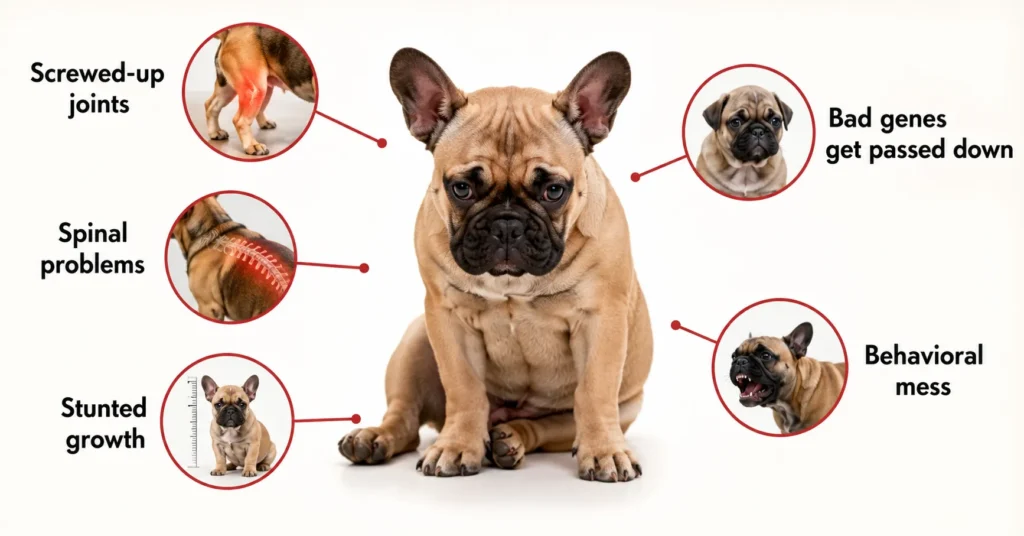
You’re gambling with his health and the puppies’ future.
Breed a male Frenchie before his body’s finished (under 18–24 months), and here’s what you’re signing up for:
Screwed-up joints
his growth plates aren’t even closed yet. Breed him early, and you’re asking for hip dysplasia, elbow dysplasia, and a lifetime of pain.
Spinal problems
Frenchies are already prone to hemivertebrae (misshapen vertebrae). Breeding early makes it worse. One bad move and he can’t walk.
Stunted growth
Breeding steals energy his body needs for its own development. He might never reach his full size.
Bad genes get passed down
hip issues, joint problems, breathing trouble all go straight to his puppies.
Behavioral mess
He’s stressed, confused, and frustrated. That turns into aggression or anxiety and puppies can inherit that too.
Bottom line:
Breed too early, and you’re setting your dog up for a lifetime of pain and your puppies up for a lifetime of vet bills. Wait until he’s at least 2 years old. It’s not complicated. It’s just doing right by your dog.
When to Retire a Male French Bulldog from Breeding
Breeding isn’t a conveyor belt. Your dog needs time to bounce back between sessions. Hit that 2 to 3 mark, and you’re being responsible. Push past it, and you’re hurting him.
Here’s what happens when you overdo it: his sperm quality drops, his energy crashes, and his health goes downhill fast. He starts looking run-down and tired. That’s not a stud. That’s a burned-out dog.
Most ethical breeders give their males a break between breeding seasons. Some only use them once a year. They know the secret: less breeding means better-quality puppies and a healthier dog.
Bottom line:
Keep it to 2 or 3 times a year tops. And if he’s over 5 years old, even that might be pushing it. Your dog’s health matters more than another litter. Don’t be greedy.
Frequently Asked Questions
At what age can a male French Bulldog start breeding?
While they can reach sexual maturity as early as 6 months, responsible breeders wait until they are at least 12 to 18 months old, with 2 years being the ideal age for full physical and mental maturity.
How many times can a male French Bulldog breed in a year?
It is recommended to limit breeding to 2-3 times per year to prevent health issues and maintain sperm quality.
Can French Bulldogs breed naturally?
Natural mating is rare and often unsuccessful due to their physical build (narrow hips, short legs); therefore, artificial insemination is the standard and recommended method.
What health tests should a male Frenchie pass before breeding?
Essential health screenings include evaluations of the hips, patellas (kneecaps), heart, and eyes, as well as spine X-rays for hemivertebrae.
How do I know if my male Frenchie is ready to breed?
He should be physically mature (at least 1-2 years old), have passed all necessary health screenings, and show a calm, confident temperament and a clear interest in females.
When should I retire my male French Bulldog from breeding?
Most guidelines advise retiring stud dogs around 5 to 6 years of age, as sperm quality and fertility decrease with age.
What happens if I breed my Frenchie too early?
Breeding too early can lead to health complications for both the sire and the offspring, as the dog is not yet fully physically mature.
How much does it cost to breed a French Bulldog?
Breeding French Bulldogs is expensive, often costing thousands of dollars due to the need for artificial insemination and the high likelihood of a C-section for the female.
Conclusion
The real answer to what age can you breed a French Bulldog male is 2 years — period. Wait for health tests, use AI, breed 2–3 times yearly, and retire by 5. Do right by your dog and those puppies, or don’t breed at all

Sarah Mitchell has been raising French Bulldogs for over 9 years in Austin, Texas. After adopting her first Frenchie, Biscuit, she became passionate about helping new owners navigate the unique needs of the breed from breathing care to diet and heat safety. Sarah has worked closely with local veterinarians and attended the AKC National Championship three times as a breed enthusiast. Her guides focus on practical, real-world advice for American Frenchie owners.