
Introduction
That jump isn’t random; it reflects a dog’s full adult dental toolkit for tearing, gripping, shearing, and grinding.
This guide covers the exact tooth count by type, the full eruption and shedding timeline, and what’s actually normal versus a sign something needs a vet’s attention.
How Many Teeth Do Dogs Have? The Short Answer

| Life Stage | Tooth Count |
|---|---|
| Puppy (deciduous/baby teeth) | 28 |
| Adult dog (permanent teeth) | 42 |
How Many Teeth Do Dogs Have? This holds true across virtually all dog breeds, regardless of size. A tiny Chihuahua and a Great Dane both carry the same 42 adult teeth, though the Chihuahua’s much smaller jaw has to fit that same number into far less space, which is exactly why small breeds face more frequent dental crowding issues than large ones.
Adult Dog Teeth: The Full Breakdown by Type
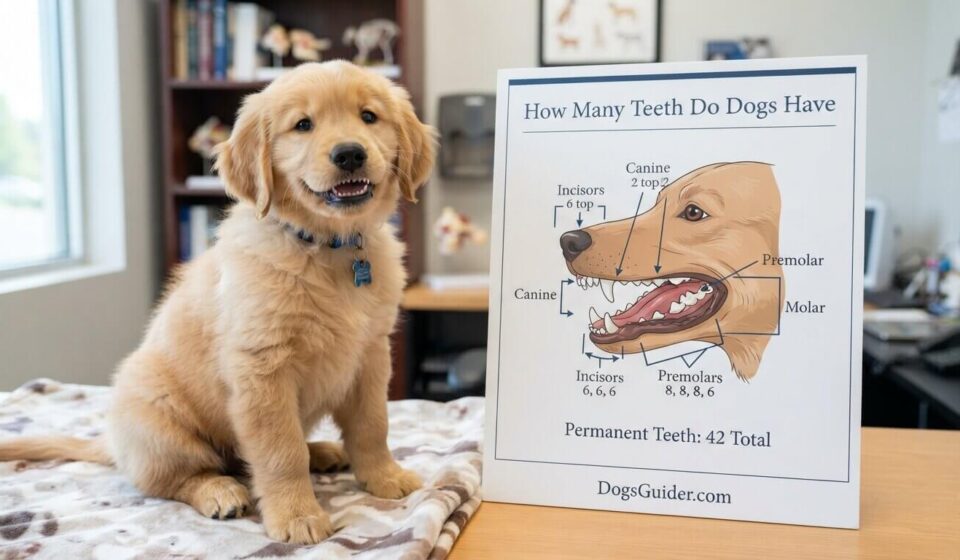
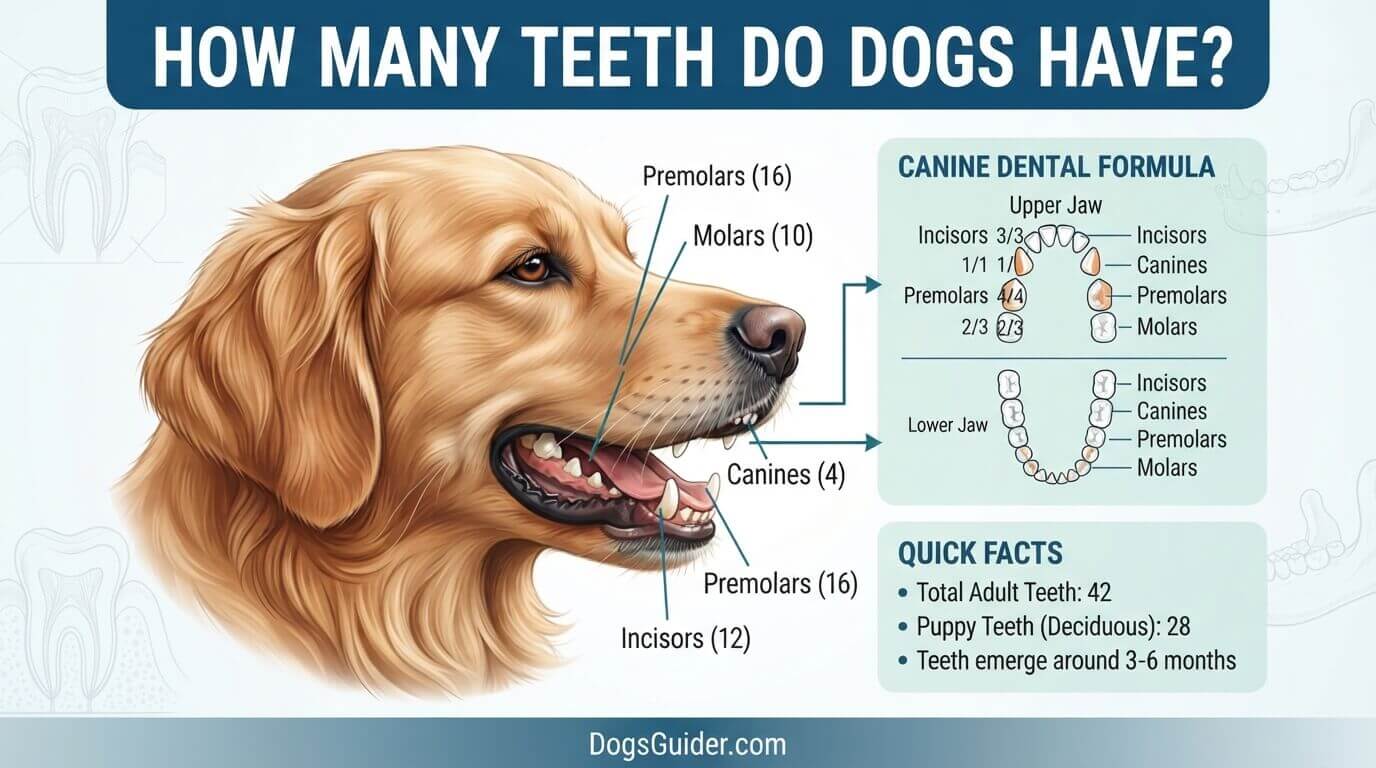
The official dental formula for an adult dog is 2 × (I 3/3, C 1/1, P 4/4, M 2/3), which works out to 42 total teeth across four types, each with a specific job:
| Tooth Type | Count | Location | Function |
|---|---|---|---|
| Incisors | 12 | 6 top, 6 bottom | Small front teeth for nibbling, scraping meat off bone, and self-grooming |
| Canines | 4 | 2 top, 2 bottom | Long, sharp “fangs” for gripping, puncturing, and tearing |
| Premolars | 16 | 8 top, 8 bottom | Sharp-edged teeth behind the canines, used for shearing food into pieces |
| Molars | 10 | 4 top, 6 bottom | Flat, heavy-duty back teeth for grinding and crushing |
Counted by jaw instead of type, adult dogs have 20 teeth on the upper jaw and 22 on the lower jaw, which is why the asymmetric 20/22 split sometimes confuses people expecting an even number on each side.
Puppy Teeth: The Full Breakdown by Type
| Tooth Type | Count |
|---|---|
| Incisors | 12 |
| Canines | 4 |
| Premolars | 12 |
| Molars | 0 |
Notice puppies have zero molars. That’s the main reason their total count (28) is so much lower than the adult total (42): molars are purely an adult-dentition addition, since puppies don’t yet need the heavy grinding power molars provide for a fully varied adult diet.
Puppy Teething Timeline: When Teeth Come In and Fall Out
| Age | What’s Happening |
|---|---|
| Birth | Puppies are born with no visible teeth |
| 2-3 weeks | Baby (deciduous) teeth begin to emerge, starting with incisors |
| 6-8 weeks | Full set of 28 puppy teeth has typically erupted |
| 3-4 months | Baby teeth begin falling out as adult incisors start pushing through |
| 4-5 months | Adult canine teeth emerge |
| 5-8 months | Adult premolars and molars come in |
| 6-7 months | Full set of 42 adult teeth is typically complete |
It’s completely normal, and safe, for owners to never find most of the 28 How Many Teeth Do Dogs Have. Puppies commonly swallow their own loose baby teeth while eating or chewing, without any ill effect.
Small Dogs Face a Unique Dental Challenge
This is a detail many general guides skip. Small and toy breeds have exactly the same 42-tooth adult count as a large breed, but have to fit it into a proportionally much smaller jaw.
This crowding contributes to why small dogs are more prone to retained How Many Teeth Do Dogs Have (which may need veterinary extraction if they don’t fall out on their own), misalignment, and a higher overall risk of dental disease over their lifetime.
What If My Dog Has Fewer Than 42 Teeth?
A missing tooth or two in an adult dog isn’t automatically alarming, but it’s worth understanding why it happens:
- Tooth breakage often happens from chewing on objects too hard for a dog’s teeth to safely handle
- Periodontal disease: advanced gum disease is a leading cause of adult tooth loss
- A tooth that never erupted: some dogs simply never develop a particular tooth, which a vet can confirm via dental X-ray
- Previous extraction for a tooth that was damaged, infected, or causing crowding
If you’re unsure why your adult dog’s count seems off, a veterinary dental exam (sometimes including X-rays) can clarify whether a tooth broke, was lost to disease, or simply never came in.
Supporting Healthy Teeth Through Both Stages

- Offer appropriate chew toys during teething to ease discomfort and redirect chewing from furniture or hands
- Start tooth brushing early with a dog-specific toothpaste, ideally once adult teeth are in, to build a lifelong routine
- Watch for retained baby teeth around 6-7 months; a baby tooth still present alongside its adult counterpart may need a vet’s attention
- Schedule regular veterinary dental checkups, since periodontal disease is one of the most common and most preventable health issues in adult dogs
Final Thoughts
So, how many teeth do dogs have? Puppies start with 28, and by around 6-7 months, most dogs settle into their full adult set of 42, organized into incisors, canines, premolars, and molars, each built for a specific job.
Understanding this timeline helps you recognize normal teething versus something that needs veterinary attention, and sets the foundation for a lifetime of good dental care.
This article is for general information and is not a substitute for veterinary advice. Consult your veterinarian if you notice retained baby teeth, unusual tooth loss, or signs of dental disease in your dog.
FAQs
1. How many teeth do dogs have as adults?
Adult dogs have 42 permanent teeth: 12 incisors, 4 canines, 16 premolars, and 10 molars, split as 20 teeth on the upper jaw and 22 on the lower jaw.
2. How many teeth do puppies have?
Puppies have 28 deciduous (baby) teeth: 12 incisors, 4 canines, and 12 premolars. Puppies have no molars, which is the main reason their total count is lower than an adult dog’s.
3. At what age do puppies get all their adult teeth?
Most puppies have their complete set of 42 adult teeth by 6 to 7 months of age, though the full process of losing baby teeth and growing adult teeth begins around 3-4 months.
4. Is it normal for a puppy to swallow its baby teeth?
Yes, it’s very common and safe. Puppies often swallow loose baby teeth while eating or chewing, which is why owners rarely find all 28 shed teeth.
5. Why does my adult dog have fewer than 42 teeth?
Common reasons include a broken tooth, periodontal disease, a tooth that never erupted, or a previous extraction. A veterinary dental exam can identify the specific cause.
6. Do small dogs have the same number of teeth as large dogs?
Yes, the total tooth count (42 adult, 28 puppy) is the same across all breeds and sizes, though small dogs face more crowding issues since the same number of teeth has to fit into a much smaller jaw.

Sarah Mitchell has been raising French Bulldogs for over 9 years in Austin, Texas. After adopting her first Frenchie, Biscuit, she became passionate about helping new owners navigate the unique needs of the breed from breathing care to diet and heat safety. Sarah has worked closely with local veterinarians and attended the AKC National Championship three times as a breed enthusiast. Her guides focus on practical, real-world advice for American Frenchie owners.