
Introduction
If you share your home with a Frenchie, you have probably already heard the letters IVDD. Owners fear this condition for good reason: it can turn a playful, healthy dog into one who yelps when picked up, or who cannot use his back legs, within hours.
The good news is that many dogs recover well when the problem is caught early. This guide explains what IVDD in French Bulldogs is, the early signs, the five stages, treatment options, realistic costs, recovery, and the practical steps that can lower your dog’s risk.
What Is IVDD in French Bulldogs?
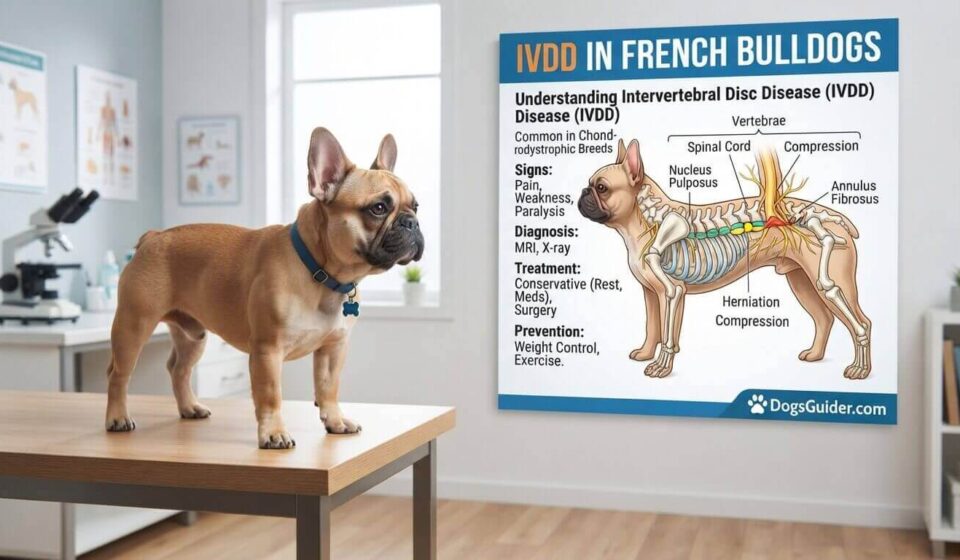
Your dog’s spine is a chain of small bones called vertebrae. Between each pair sits a disc that works like a shock absorber: a tough outer ring with a soft, jelly-like centre.
Intervertebral disc disease happens when that cushion hardens, weakens, bulges or bursts into the narrow canal that holds the spinal cord.
When disc material hits the spinal cord, it causes pain, nerve damage and, in serious cases, paralysis. IVDD in French Bulldogs, this usually happens as a sudden disc extrusion, where the jelly centre escapes at speed and bruises the cord.
Veterinary research describes IVDD as the most commonly reported neurological problem in the breed. In one study, it made up roughly 45% of neurological cases in French Bulldogs.
Why Are French Bulldogs So Prone to IVDD?

IVDD in French Bulldogs are a chondrodystrophic breed. Their genes give them short legs and a compact body, but also discs that dry out and calcify much earlier than in other dogs.
Dachshunds, Beagles, Basset Hounds, and Corgis belong to the same group. Several other factors can raise the risk further:
- Genetics: the body shape that makes Frenchies so cute is tied to weaker discs.
- Young age: Frenchies are often diagnosed earlier than other breeds, and some show signs at two or three years old.
- Neck problems: compared with many breeds, Frenchies suffer more disc disease in the neck (cervical spine).
- Extra weight: every spare kilo adds strain to the spine.
- High-impact movement: jumping off sofas, running stairs, and rough play.
- Neck collars: pulling on a collar puts pressure on the neck.
IVDD Symptoms in French Bulldogs: Early Signs to Watch For
Symptoms depend on where the damaged disc is and how badly the spinal cord is injured. Some dogs show only mild discomfort at first, which is why owners often miss the early signs.
Neck (Cervical) IVDD Signs
- Holding the head low or stiffly
- Yelping when touched or when turning the head
- Refusing to eat or drink from a raised bowl
- Muscle spasms or a stiff, “guarded” neck
Back (Thoracolumbar) IVDD Signs
- A hunched or arched back and a tucked belly
- Reluctance to jump, climb stairs, or play
- Wobbly, swaying, or “drunk” walking in the back legs
- Knuckling, where the paws scuff or turn under
- Trembling, panting or restlessness from pain
Emergency Signs: Go to a Vet Now
- Cannot stand or walk, or drags the back legs
- Loss of bladder or bowel control
- No reaction when the toes are gently pinched
- Sudden screaming pain
IVDD can move from mild discomfort to paralysis in a matter of hours, so never “wait and see” with back pain in a Frenchie.
The 5 Stages (Grades) of IVDD in Dogs
Vets grade IVDD in French Bulldogs from 1 to 5. The grade matters because it decides the treatment and strongly affects the chance of recovery.
| Stage | What You See | Usual Approach |
|---|---|---|
| 1 | Pain only, walking normally | Crate rest and medication |
| 2 | Walks but is wobbly or weak | Crate rest and medication, or surgery |
| 3 | Cannot walk unaided, still moves the legs | Surgery usually advised |
| 4 | Paralysed but can still feel pain in the toes | Urgent surgery |
| 5 | Paralysed with no deep pain sensation | Emergency surgery, guarded outlook |
Your vet or neurologist makes the final call, and treatment choices can differ between clinics.
How Vets Diagnose IVDD
Many conditions can look like IVDD, so a confirmed diagnosis is one of the most important steps toward a good outcome. Expect the following:
- Neurological exam: checks reflexes, walking, posture, and pain response.
- X-rays: can show narrowed disc spaces but cannot see the spinal cord itself.
- MRI or CT scan: the best way to see exactly which disc is the problem, and usually needed before surgery.
Your vet also needs to rule out other causes of back weakness in bulldogs, such as a spinal stroke (FCE), spinal malformations, or infection.
IVDD Treatment Options for French Bulldogs
1. Conservative Treatment: Crate Rest and Medication
This suits dogs with mild signs, usually pain only or mild wobbliness. The plan normally includes:
- Strict crate rest, commonly for around four to six weeks
- Prescription anti-inflammatories, pain relief and muscle relaxants
- Short, controlled toilet breaks on a lead with a harness
Important: never give human painkillers such as ibuprofen or paracetamol, and never combine steroids with anti-inflammatories unless your vet tells you to. Both can be dangerous for dogs.
2. Surgery
Surgery removes the disc material pressing on the cord. It is usually recommended for dogs who cannot walk, who do not improve with rest, or whose pain keeps returning.
Dogs who have lost deep pain sensation need surgery as an emergency, ideally within about 24 to 48 hours. Some neurologists also offer a preventive procedure on neighbouring discs, which you can ask about.
IVDD Surgery Cost
Costs vary widely by country and clinic. As a rough guide in the US, an MRI often costs around $1,500 to $3,000, and surgery with hospitalisation commonly runs from about $3,000 to $9,000 or more.
Rehabilitation adds to this. Pet insurance taken out before any back problem appears can save you a great deal, so it is worth considering when you first bring a puppy home.
Recovery and Prognosis
The outlook is often good. Dogs with mild signs and dogs who can still feel their toes tend to have the best chance of walking again.
Recovery is slower for dogs with severe signs, and the chance drops for dogs who have lost deep pain sensation. Recurrence is a real issue in this breed.
Research on surgically treated Frenchies found that IVDD in French Bulldogs can return in more than half of dogs, especially in the neck of younger dogs. This is why long-term prevention matters even after a full recovery.
Rehabilitation such as hydrotherapy, physiotherapy, and guided exercise helps rebuild strength. Dogs who cannot walk may need help with bladder care, and severe spinal injury can rarely lead to a life-threatening complication called myelomalacia, which is another reason to treat paralysis as an emergency.
What to Do If You Suspect IVDD: Step by Step
- Keep your dog still. Confine him in a crate or small pen right away.
- Lift carefully. Support the chest and hindquarters together and keep the spine straight.
- Call your vet or an emergency clinic. Describe when it started and how fast it is progressing.
- Do not give human medicine.
- Ask for a referral to a veterinary neurologist or a hospital with MRI if signs are moderate or severe.
How to Prevent IVDD in French Bulldogs
You cannot change genetics, but you can reduce strain on the spine:
- Keep your Frenchie lean. A healthy weight is the single biggest thing you control.
- Use a harness, not a collar, for walks.
- Add ramps or pet stairs for beds and sofas so he never has to jump.
- Limit stairs and rough, high-impact play.
- Keep him fit with steady, controlled walks that build core muscle.
- Raise food bowls slightly if he has neck pain, on your vet’s advice.
- Pick a responsible breeder who screens for spinal health and breeds sound dogs.
Living With an IVDD Frenchie
A diagnosis is not the end of a happy life. Many Frenchies go on to live comfortably for years with the right support. Non-slip rugs, ramps, a well-fitted harness and a carefully managed weight make daily life safer.
Dogs who stay partly or fully paralysed can use a custom dog wheelchair, and many adapt surprisingly well. Regular rehab check-ups help you spot any setback early.
Final Thoughts
IVDD in French Bulldogs is serious, but it is not hopeless. Know the early signs, act fast at the first hint of back or neck pain, and protect the spine every day with weight control, ramps, and a harness.
Early action is what gives your dog the best chance of a full, comfortable recovery.
FAQs
1. At what age do French Bulldogs get IVDD?
Signs can start as early as age 2 or 3, although the risk continues to rise into adulthood. Frenchies are usually diagnosed at a younger age than many other breeds.
2. Can a French Bulldog recover from IVDD without surgery?
Yes, dogs with mild signs such as pain or slight wobbliness can improve with strict crate rest and vet-prescribed medication. Dogs who cannot walk generally need surgery.
3. How much does IVDD surgery cost for a French Bulldog?
It varies by location, but surgery often falls between about $3,000 and $9,000 in the US, plus $1,500 to $3,000 or more for an MRI. Ask your clinic for a written estimate.
4. How long does it take a French Bulldog to recover from IVDD?
Crate rest usually lasts around four to six weeks, and full recovery after surgery can take weeks to months depending on severity and rehab.
5. Can IVDD come back after treatment?
Yes. Research suggests recurrence can affect more than half of surgically treated Frenchies, which is why weight control and spine-friendly habits remain important for life.
6. Is IVDD painful for dogs?
It can be very painful, especially in the neck and in early stages. In severe cases, the dog may lose feeling in the legs, which is an emergency.
7. How long can a French Bulldog live with IVDD?
Many dogs live for years after diagnosis when treated early and managed well. Quality of life depends on severity, recovery, and ongoing care.
8. Should I use a collar or harness on my French Bulldog?
A harness is safer because it keeps pressure off the neck and spine.

Sarah Mitchell has been raising French Bulldogs for over 9 years in Austin, Texas. After adopting her first Frenchie, Biscuit, she became passionate about helping new owners navigate the unique needs of the breed from breathing care to diet and heat safety. Sarah has worked closely with local veterinarians and attended the AKC National Championship three times as a breed enthusiast. Her guides focus on practical, real-world advice for American Frenchie owners.